

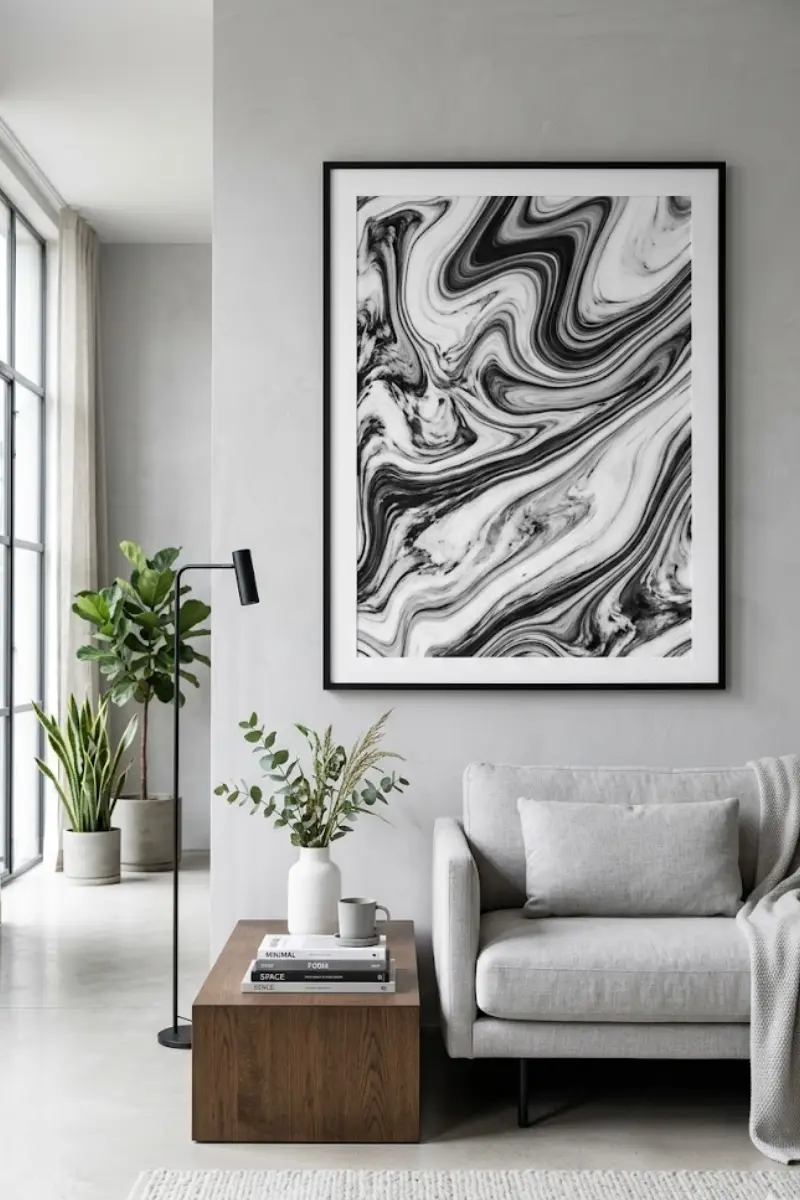


A gallery wall works when one piece anchors it and everything else supports that piece, not when you hang five equally sized frames and hope they look intentional together.
Start with the anchor, then build out using real spacing rules instead of guesswork.
Start With One Large Anchor Piece
Pick your biggest piece first and hang it before anything else touches the wall.
A three-panel triptych like this one works as an anchor because it already reads as one visual unit even though it’s three separate canvases, so the rest of the wall has something clear to build around instead of competing pieces of equal size.
Group in Odd Numbers, Not Even
Odd-numbered groupings of three, five, or seven pieces read as intentional in a way even numbers rarely do.
Add a single mid-size canvas like this one next to your anchor, then keep building outward in odd counts rather than pairing pieces symmetrically, which tends to look more like a matched furniture set than curated art.
Leave 2 to 3 Inches Between Every Frame
Tighter than 2 inches and the wall reads cluttered.
Wider than 3 inches and the grouping stops reading as one wall and starts looking like separate, unrelated pieces.
A smaller framed print like this one is the easiest piece to test that spacing on, since it’s simple to reposition before you commit to a nail.
Center the Whole Grouping at Eye Level
The visual center of the entire arrangement, not just the biggest piece, should land around 57 to 60 inches off the floor.
That’s the standard museum eye-level height, and it’s what makes a gallery wall look designed instead of placed wherever there happened to be room.
Map It Out on the Floor or With Paper Templates Before You Drill
Trace each frame onto craft paper, cut it out, and tape the shapes to the wall in your planned layout before a single nail goes in.
Leave the paper up for a full day and you’ll catch problems, like a piece sitting right at a light switch or outlet, before they’re permanent.
FAQ
How many pieces do I need for a living room gallery wall? Three to seven works for most living room walls.
Fewer than three doesn’t read as a “gallery,” and more than seven starts to need a second anchor piece to keep it organized.
What’s the standard spacing between frames? 2 to 3 inches.
That’s tight enough to read as one connected grouping and loose enough that each piece still gets its own visual space.
How high should a gallery wall be hung? Center the whole grouping, not just the largest frame, at 57 to 60 inches off the floor.
That’s standard eye-level height and the same rule galleries and museums use.
Do all the frames need to match? No. A mix of canvas and framed prints in a shared color story, gold, black, ivory, reads more curated than a matched set.
What needs to match is the palette, not the frame style.
See the full breakdown by type and style in our wall décor buying guide.
Add us to your preferred sources to see our latest room styling guides and luxury decor edits first in your Google feed.
Ideas & Inspiration
Tired of cold, empty living room walls? Discover 5 stunning art deco mirrors and metal …
Read guide →
Flat wall prints often feel uninspired. Here are 7 dimensional metal, gold leaf, and …
Read guide →
Real Art Deco wall decor means one geometric brass statement piece, not a room of matching …
Read guide →